Monthly Archives :

April 2025

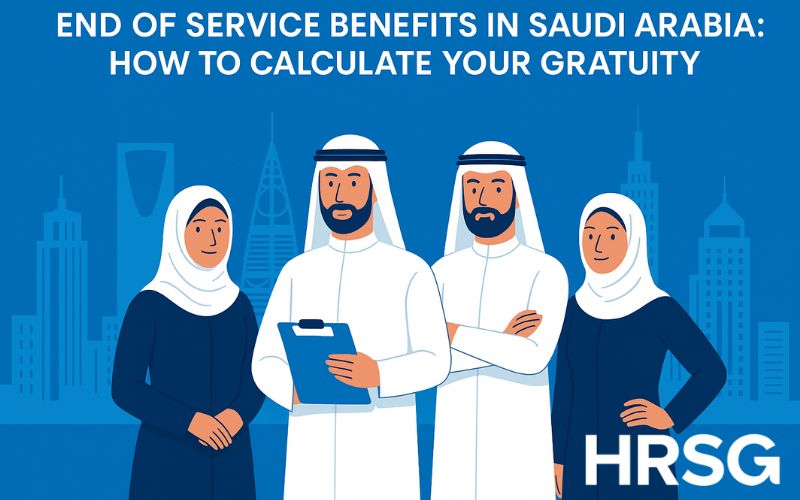
End of Service Benefits in Saudi Arabia: How to Calculate Your Gratuity

End of Service Benefits in Saudi Arabia: How to Calculate Your Gratuity

End of Service Benefits in Saudi Arabia: How to Calculate Your Gratuity 800 500 HRSG

Think of the end-of-service benefits in Saudi as a financial cushion for employees at the end of their contract. Whether you’re moving on to a better opportunity or heading home after years in the Kingdom, the end-of-service benefit, also known as gratuity, is a legal right under Saudi Labor Law. The good part? It applies to Saudi nationals as well as expatriates. 

In this blog, we will break down the concept of gratuity and help you understand the following things:

  • What are the end-of-service benefits?
  • Law addressing end-of-service benefits in Saudi Arabia
  • End-of-service benefits in Saudi
  • Who is entitled to gratuity benefits? 
  • How to calculate your gratuity

What are the End of Service Benefits?

Gratuity, also known as End of Service Benefits (EOSB), is a financial reward given by an employer to an employee in recognition of their dedication, hard work, and service over the course of their employment. It is typically paid out when the employment relationship ends, whether due to resignation or termination.

Under Saudi labor law, an employee who resigns becomes eligible for gratuity after completing two years of continuous service with the same company.

On the other hand, if the employee is terminated, they are entitled to the full accrued gratuity provided they have completed at least one year with the company. For employers, gratuity represents a financial obligation that must be accounted for.

According to Article 2 of the Saudi Labor Law, all fixed components of an employee’s salary are included in the calculation of end-of-service benefits in Saudi Arabia. These include:

  • Basic salary
  • Housing allowance
  • Transportation allowance
  • Mobile allowance

On the other hand, variable benefits, such as sales incentives, ticket allowances, and bonuses, are excluded from the calculation as they depend on other factors.

Law Addressing End-of-Service Benefits in Saudi Arabia

The end-of-service benefits in Saudi Arabia are governed by the Saudi Labor Law under Articles 84 to 88. 

  1. Article 84: When an employee’s work ends, the employer must pay an end-of-service benefit. This includes:
  • Half a month’s salary for each of the first five years of service
  • One month’s salary for each year after that

The benefit is based on the employee’s last salary and should also include a proportional amount for any partial year worked.

  1. Article 85: If the employee resigns:
  • They receive one-third of the benefit if they’ve worked between 2 and 5 years
  • Two-thirds if they’ve worked more than 5 but less than 10 years
  • The full benefit if they’ve worked 10 years or more
  1. Article 86: It can be agreed that the salary used to calculate the end-of-service benefit does not include certain variable components like commissions or sales percentages.
  2. Article 87: Despite what’s stated in Article 85, the employee is entitled to the full benefit if they leave due to a situation beyond their control (force majeure). Also, a female employee gets the full benefit if she ends her contract within:
  • 6 months of getting married, or
  • 3 months after giving birth
  1. Article 88: When employment ends:
  • The employer must pay the employee’s wages and all dues within one week.
  • If the employee ends the contract, the employer has up to two weeks to settle the dues.
  • The employer can deduct any outstanding work-related debts from the employee’s final payment.

Benefits of End-Of-Service Benefits in Saudi

The end-of-service benefits in Saudi Arabia provide financial security and reward employees for their long-term service commitment.

  • EOSB offers a lump sum payment that helps employees manage expenses while transitioning between jobs or planning retirement.
  • Knowing there’s a significant reward at the end of long-term service motivates employees to stay longer with the organization.
  • The payout can be a key part of an employee’s retirement plan, especially for expatriates returning to their home country.
  • It acts as a token of appreciation for an employee’s dedication and years of service to the company.
  • In cases where jobs end unexpectedly, EOSB can help cover immediate living expenses or relocation costs.

Who is Entitled to Gratuity Benefits

The end-of-service benefits in Saudi Arabia are provided to both Saudi citizens and expatriate workers, as long as they’re employed under the country’s labor laws. The key factor for eligibility isn’t nationality but rather the length of continuous service with an employer. 

Minimum Service Requirements

To qualify for EOSB, an employee must complete a certain period of continuous service. These requirements are set by Saudi labor law and may differ depending on the employment contract type and the industry.

Here’s a simple breakdown of how minimum service requirements affect EOSB eligibility:

If the employer terminates the contract (not due to misconduct):

  • Less than 1 year: No EOSB is paid.
  • 2 to 5 years: Half a month’s salary for each year of service.
  • More than 5 years: Full benefit is paid.

If the employee resigns:

  • Less than 2 years: No EOSB
  • 2 to 5 years: One-third of the total EOSB
  • 5 to 10 years: Two-thirds of the total EOSB
  • More than 10 years: Full EOSB

The reason for ending the employment also influences EOSB eligibility:

  • Terminated by Employer (No Misconduct): The employee is eligible for EOSB if they meet the required minimum service duration. The payout depends on how long they’ve worked.
  • Terminated for Misconduct: In most cases, the employee loses their EOSB, especially if it’s clearly mentioned in their employment contract.
  • Mutual Agreement: If both parties agree to end the contract, EOSB is usually paid as per the terms outlined in the mutual agreement.

Employment contract KSA

How To Calculate Your Gratuity

In Saudi Arabia, gratuity payouts are based on two main factors: the employee’s basic salary and how long they’ve worked with the company. Let’s understand the process with an example. 

Suppose an employee was terminated by the employer, and there was no misconduct. 

Service duration: 7 years and 6 months (i.e., 7.5 years)

Step 1: Consider the Last Monthly Salary 

Last Monthly Salary = SAR 11,500

Step 2: Calculate the Benefits for the First 5 Years 

For years 1–5, a half-month salary for each of the first five years is required to be calculated. Therefore:

5 years × 0.5 month × SAR 11,500 = SAR 28,750

Step 3: Calculate the Benefits for the Remaining Years 

For years 6–7.5 (2.5 years), one full month’s salary for each year is required to be calculated. Therefore:

2.5 years × 1 month × SAR 11,500 = SAR 28,750

Step 4: Calculate the Total EOSB

To calculate the total EOSB, add a half-month salary for each of the first five years and one full month’s salary for each year.

SAR 28,750 (first 5 years) + SAR 28,750 (next 2.5 years) = SAR 57,500

Conclusion

End-of-service benefits in Saudi Arabia are mandatory payments employers make to employees when their job ends. Whether you’re a Saudi national or an expat, end-of-service benefits in Saudi Arabia are a reward for your dedication, service, and time invested in your role. 

These benefits offer financial security, reward long-term service, and apply to both Saudis and expats. That being said, gratuity eligibility depends on service duration, with clear rules on how it’s calculated under Saudi labor law.

HRSG is a leading HR services company in Dubai, globally known for its world-class business solutions. Our HR and payroll solution, Octofy®, simplifies and automates the way you manage your workforce. Consequently, it makes HR task management easier, more efficient, and more effective than ever. Contact us today and see what we have for you. 
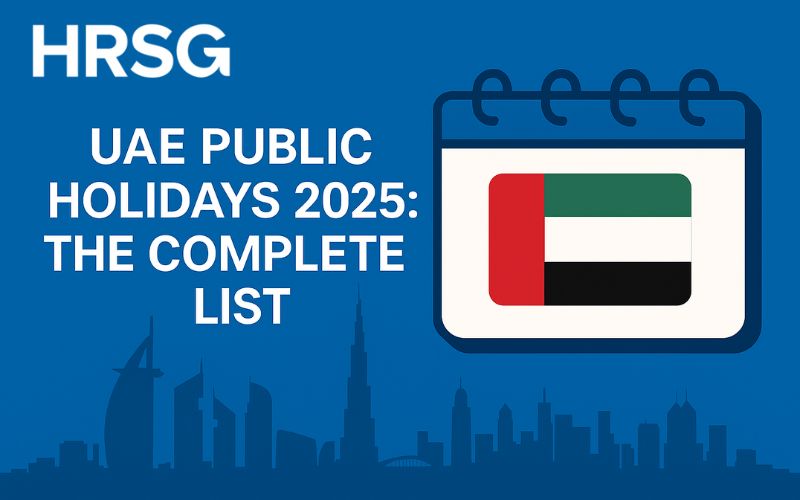
UAE Public Holidays 2025: The Complete List

UAE Public Holidays 2025: The Complete List

UAE Public Holidays 2025: The Complete List 800 500 HRSG

2025 is a sweet mix of holidays, religious celebrations, national pride, and potential long weekends. Long weekends, fireworks, staycations, and mini vacations. Yes, it’s that time again!

Whether you are a 9-to-5 employee mapping out leave days or a tourist trying to catch Dubai’s famous National Day fireworks, knowing the UAE’s public holidays in advance is a hack to epic plans.

For this reason alone, we have crafted a list of UAE Public Holidays for you. Let’s go through it date by date, with tips on how to make the most of each one.

At a Glance: UAE Public Holidays 2025

Date Day Holiday No. of Days
1st January Wednesday New Year’s Day 1 Day
30th March Sunday  Eid Al-Fitr Start 5 Days
5th June Thursday  Arafat Day 1 Day
6th June Friday  Eid Al-Adha Start 3 Days
26th June Thursday  Islamic New Year 1 Day
5th September Friday  Prophet Muhammad’s Birthday 1 Day
30th November Sunday  Commemoration Day 1 Day
2nd December Tuesday  UAE National Day 1 Day

Note: Dates for Islamic holidays (Eid and Islamic New Year) may vary depending on the sighting of the moon.

Past Holidays

January 1 – New Year’s Day

The year starts with a global celebration: New Year’s Day on January 1st. You can expect fireworks in popular areas like Dubai Marina, Downtown Dubai, and Abu Dhabi Corniche. It’s a public holiday across all seven emirates. So, residents can relax after the busy holiday season or begin the year with a little getaway.

March 30 to April 3 – Eid Al-Fitr

Eid Al-Fitr translates to “Festival of Breaking the Fast.” It marks the end of Ramadan, a holy month of fasting, prayer, and reflection. 

In 2025, Eid Al-Fitr is expected to begin on Sunday, March 30th. The holiday is set to last 5 days. That’s one of the longest holiday breaks of the year!

Upcoming Holidays

June 5 – Arafat Day

Arafat Day, falling on Thursday, June 5th, is the second most important day in the Islamic calendar after Eid Al-Fitr. It takes place during Hajj, the pilgrimage to Mecca. Muslims spend the day in prayer and fasting, reflecting on forgiveness and compassion. 

Millions of people gather at Mount Afrat as on this day, Prophet Muhammad, peace be upon him, delivered his Farewell Sermon during his final pilgrimage in 632 CE. 

It’s a single-day holiday. But as it’s followed directly by Eid Al-Adha, it becomes a part of a potential long weekend or extended break.

June 6 to June 8 – Eid Al-Adha

Eid Al-Adha is also known as the “Festival of Sacrifice.” It begins on Friday, June 6th, and spans 3 days. It honors the willingness of Prophet Ibrahim to sacrifice his son in obedience to Allah’s command.

Traditionally, families who can afford it sacrifice an animal (a sheep or a goat) with a portion shared with the less fortunate. The animal represents the lamb that Prophet Ibrahim sacrificed to Allah. It’s a time of charity, compassion, and celebration. 

In some places, however, sacrificing an animal is not allowed. In such cases, people buy meat from meat shops and donate the same. Or they directly donate money to charities that arrange meat for the poor. 

What to expect:

  • Special mosque prayers
  • Long family lunches
  • Charity efforts across the UAE
  • Cities like Dubai to lit up 
  • Shopping malls and cinema halls to set up massive discounts 
  • Exquisite food like Quzi, Chicken Machboos, and Luqaimat.

Eid Al-Adha 2025 UAE

June 25 – Islamic New Year

The Islamic New Year, also called Hijri New Year, is expected to fall on Wednesday, June 25th, 2025, as per the current astronomical predictions. The exact date would depend on whether Dhu Al Hijjah, the 12th and final month in the Islamic calendar, is a 29-day or 30-day month.

It commemorates the Prophet Muhammad’s migration from Mecca to Medina. It also marks the beginning of the new Islamic lunar year. It is believed to be the start of the holiest month after Ramadan. 

The Islamic New Year, is typically observed as:

  • Dry day
  • All hotels, public spaces, and educational institutions remain close

Additionally —

  • Mosques hold special prayers and speeches discussing the importance Hijra
  • Families get together and eat together

September 4 – Prophet Muhammad’s (PBUH) Birthday

Mawlid Al-Nabi is the birthday of Prophet Muhammad (PBUH). It is expected to fall on Friday, September 4th, 2025. It’s not a flashy celebration. But many mosques host special sermons. Also, people often reflect on the Prophet’s teachings and values.

It’s typically a day of rest, spiritual reflection, and community. For many, it’s also a great chance to spend time with family or enjoy a peaceful Friday.

November 30 – Commemoration Day

It was in 2015, the late His Highness Sheikh Khalifa Bin Zayed Al Nahyan declared November 30th as Commemoration Day, previously known as Martyr’s Day. It honors the Emiratis who have sacrificed their lives in service to the UAE, like the first Emirati martyr, Salem Suhail bin Khamis. 

This day holds great emotional and national significance. Schools and workplaces pause to remember and reflect. A moment of silence is held at 11:30 AM across the country. Some of the initiatives taken by the UAE government to honor the martyrs are:

  • Housing programs to ensure their family’s stability
  • Quality education for the children 
  • Establishing Martyrs’ Families’ Affairs Office at the Crown Prince Court.

December 2 – UAE National Day

This is the big one!

UAE National Day falls on Tuesday, December 2nd. It commemorates the unification of the seven emirates into one country in 1971. It’s one of the most vibrant and patriotic times in the UAE.

What to expect:

  • Fireworks in Dubai, Abu Dhabi, and Sharjah
  • UAE flag on Burj Khalifa
  • Air shows at the Abu Dhabi National Exhibition Centre for the rulers of the Emirates, members of the Federal National Council, and Emirati citizens
  • Special aerial displays by UAE Air Force aerobatic team, Al Fursan
  • Free concerts and cultural shows
  • Decorations in red, green, black, and white everywhere, from cars to skyscrapers

In some years, December 3rd is also granted as an extra day off. So, this becomes a 2 or 3 day celebration. Keep an eye out for government announcements.

UAE National Day 2025

4 Tips to Make the Most of Your Time Off in 2025

Want to turn these holidays into mini-vacations? It is said that you can turn these 13 days of holiday into 45 days off with smart planning. Here are a few clever tricks:

  1. Plan leaves around long weekends, like Eid holidays, Islamic New Year, or Commemoration Day, to get more days off using just 3–4 leave days.
  2. Book early, especially for Eid and National Day. Hotels and flights can get pricey.
  3. Explore within the UAE. Don’t underestimate staycations. Ras Al Khaimah, Fujairah, and Al Ain offer relaxing retreats.
  4. Be flexible with Eid dates. They depend on moon sightings. So, confirm travel only after official announcements.

Wrapping Up

2025 is a balanced year of work and rest in the UAE. With multiple long breaks and a mix of solemn observances and national celebrations, there’s something for quiet family time, spiritual reflection, or vibrant fireworks.

Knowing these dates helps you plan better. On top of that, you can understand the rich cultural and religious fabric that makes the UAE such a unique place to live or visit.

So go ahead. Mark your calendar. Set reminders. Start planning your 2025 around these beautiful moments of pause and celebration.

HRSG is globally renowned for its HR services in Dubai. Our experience in simplifying business complexities and driving agility in your organization can set your business for unprecedented growth and productivity. Contact us today and see what we can do for you.


Image Enquiry