Monthly Archives :

July 2025

UAE Corporate Tax Fine Waiver

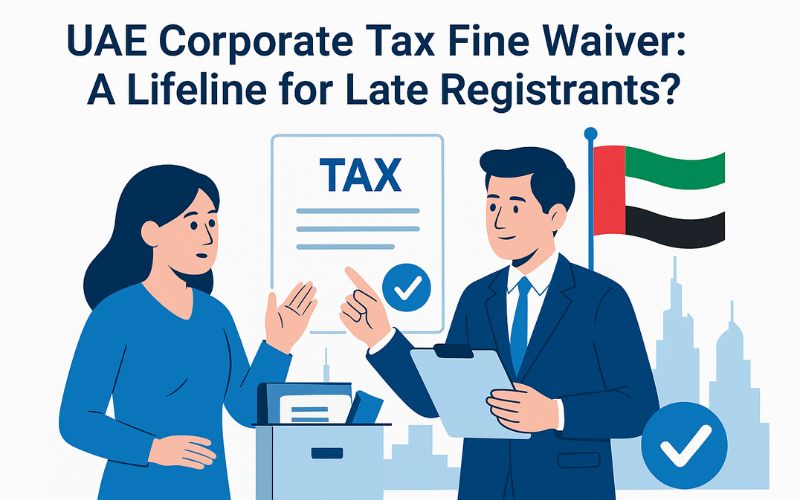
UAE Corporate Tax Fine Waiver: A Lifeline for Late Registrants?

UAE Corporate Tax Fine Waiver: A Lifeline for Late Registrants? 800 500 HRSG

It is not easy for businesses, especially if they are small and startups, to adapt to the new and evolving tax framework of the UAE, which can make compliance difficult.

Recognizing this fact, the Ministry of Finance UAE and the Federal Tax Authority have introduced a new initiative called the UAE Corporate Tax Fine Waiver 2025. This waiver has been introduced to reduce financial and administrative burdens for businesses that registered late for the corporate tax but have demonstrated a good-faith effort to comply with the UAE corporate tax regime.

This waiver is truly a lifeline for businesses that were not able to do their corporate tax registration on time, as it gives them an opportunity to ease into the new tax policies of the region without being subject to immediate financial penalties.

This blog covers the ins and outs of the corporate tax penalty waiver UAE 2025, highlighting the conditions under which a business may qualify. Keep reading to learn more.

  • The Objectives of the UAE Late Corporate Tax Registration Fine Waiver
  • Conditions for Getting the UAE Late Corporate Tax Registration Fine Waiver
  • UAE Late Corporate Tax Registration Fine Waiver: Who Can Qualify?
  • Actions That FTA Will Take to Waive the Fines
  • Important Points to Keep in Mind
  • How To Receive the Corporate Tax Late Registration Penalty Waiver

The Objectives of the UAE Late Corporate Tax Registration Fine Waiver

The UAE government introduced a temporary corporate tax penalty waiver in April 2025 to help businesses adapt to the new tax regulations. This waiver can help businesses avoid an AED 10,000 late registration penalty if they meet specific conditions.

The UAE Corporate Tax Fine Waiver is an initiative that has been introduced to give relaxation to late applicants of the corporate tax registration. Companies that submitted their tax registration applications late but filed their tax returns within the 7-month grace period may be eligible for the waiver.

Here are the main objectives of this waiver:

  • To encourage and ensure early or timely compliance with the latest tax regulations.
  • To reduce the financial burden on startups and SMEs.
  • To promote a culture of tax transparency and financial responsibility.
  • To strengthen the UAE’s position as a business-friendly destination.
  • To align with the best global corporate tax practices.

Conditions for Getting the UAE Late Corporate Tax Registration Fine Waiver

The following are some conditions that a business must fulfill to be able to get the FTA late corporate tax registration fine waiver:

  • Taxable entities must submit their tax returns within 7 months from the end of their first tax period instead of the standard 9-month period.
  • Exempt entities that were subject to the fines but were later approved for the exemption can also file their annual declaration or tax returns in the same timeframe to benefit from the waiver.
  • This initiative applies to both the entities that have not submitted their registration application and the ones that have already incurred penalties due to delayed corporate tax registration.

UAE Late Corporate Tax Registration Fine Waiver: Who Can Qualify?

Every corporate entity under the FTA corporate tax regime is eligible for the fine waiver provided they meet the above conditions. The following section lists some common scenarios where this waiver is applicable. So, keep on reading to determine whether you fall into one of these categories.

Scenario 1

Businesses that registered late and have already received a penalty but haven’t yet paid it may still qualify for a waiver, provided they submit their returns within 7 months of the financial year-end.

Scenario 2

This scenario deals with businesses that registered late and have not paid their penalties or filed their returns. These businesses have to file their returns within 7 months from the end of their first tax period to become eligible for the waiver. 

Scenario 3

In this case, businesses that have paid their penalties but not the tax returns can get their money back. To do that, they need to file their returns within the required time and apply for a refund of the penalty paid.

Scenario 4

In this case, a business that registered late has already paid the penalties and filed its returns. The tax account of such businesses will receive a refund of the penalty amount for showing good faith.

Scenario 5

In this scenario, the business has neither registered on time nor filed its returns before the deadline. If such businesses get registered and file their returns within seven months, their penalty will be waived.

corporate tax uae

Actions That FTA Will Take to Waive the Fines

If you meet the conditions for the waiver and your case is similar to one of the above-mentioned scenarios, the FTA will take the following actions to issue the late corporate tax registration fine waiver:

  • For unpaid penalties, the fine will be waived, and it will not appear as payable on the EmaraTax Corporate Tax account of the taxable person.
  • If the penalties are paid, AED 10,000 will automatically be refunded to the EmaraTax Corporate Tax account of the business.
  • If FTA receives a reconsideration request for the late registration penalty, the request will be considered null and void, as the penalty is already waived.
  • If the reconsideration request was already received and approved, that business will not be eligible for further waivers.

Important Points to Keep in Mind

The following are some key points that you need to keep in mind when it comes to the UAE Corporate Tax Fine Waiver.

  • This waiver applies only to the first tax period, whether it is in the past or the future.
  • This initiative doesn’t affect the deadline for filing Corporate Tax Payable, which is 9 months following the end of the first tax period.
  • If you belong to a tax group and the group files its returns within 7 months from the end of the first tax period, all members will have their penalties waived, even if they individually are subject to the late registration penalty.

How To Receive the Corporate Tax Late Registration Penalty Waiver

Here are some steps that you need to follow to claim your corporate tax late registration penalty waiver:

  • Visit the official EmaraTax platform and register for corporate tax.
  • File your tax return within 7 months following the end of your first tax period.
  • Ensure that all your financial records and documents are updated, accurate, and according to the standards set forth by the International Financial Reporting Standards (IFRS).
  • Apply for the penalty refund by submitting proof of timely filing via the EmaraTax portal.

Conclusion

The corporate tax fine waiver for late registration is an incredible initiative that highlights the UAE’s commitment to creating a business-friendly environment where every entity is encouraged to fulfill their tax obligations without being subject to financial or administrative burdens.

This waiver allows businesses to adapt to the evolving tax landscape of the UAE and avoid or reclaim penalties that they might have incurred due to late tax registration.

Businesses can now submit their corporate tax returns within the prescribed 7-month grace period to avoid a fine of up to AED 10,000 or receive a refund if already paid. This gives much-needed relief to SMEs to familiarize themselves with the current corporate tax laws of the UAE.

You can visit us at HRSG to get comprehensive corporate tax services, including registration, filing, reporting, and more. Our dedicated team of experts will ensure you stay compliant with every UAE tax law and face no financial liabilities. 
Frequently Asked Questions on VAT in UAE

Frequently Asked Questions on VAT in UAE

Frequently Asked Questions on VAT in UAE 800 500 HRSG

VAT or value-added tax is an indirect tax that the government of the UAE collects on goods and services at each step of the supply chain. This tax was introduced in the UAE in January 2018 at a fixed rate and with some exemptions. This tax is called an indirect tax as it is not directly collected by the government from the taxpayer.

It is the supplier of goods and services who invoices the VAT and then collects it from the consumer. The supplier will then report and submit the taxable income to the tax authorities.

As a business operating in the UAE, it is imperative that you familiarize yourself with every aspect of VAT to make sure you file your returns timely and accurately. To facilitate that, this blog lists some of the most common FAQs that most people have about VAT in the UAE.

These FAQs will help you carry out your VAT duties and show full compliance in the UAE, so keep on reading till the end.

What is VAT?

VAT, or value-added tax, is a tax levied on goods and services at all stages of the supply chain from production to distribution. This tax was introduced in the UAE in January 2018. 

This tax is ultimately paid by the consumer, and the businesses act as intermediaries who add this tax to the cost of the product and then collect and pay it to the Federal Tax Authority (FTA).

What are the VAT Rates?

The FTA has specified a fixed VAT rate of 5% for goods and services that are sold in the UAE. This standard rate is applicable to all goods and services that do not belong to the zero-rated or VAT-exempt categories.

Who is a Taxable Person?

Any person, i.e., natural, legal, or corporate entity that conducts business in the UAE and generates income that exceeds a threshold of AED 375,000 annually, is considered a taxable person under the VAT Decree-Law No. 8 of 2017. Under this law, such persons or entities must register for VAT to avoid legal or financial issues. 

What are Taxable Supplies? 

These are all goods and services that don’t belong to the exempt or Zero-rated supply categories. The general VAT rate for these supplies is 5%. This means if a supplier sells an item that costs him 100 AED, he must add 5% VAT to it. This will bring the total cost of the item to AED 105 that the consumer will have to pay in this case.

What are the Limits for Mandatory and Voluntary VAT Registration?

There are two main types of VAT registration in the UAE, i.e., Mandatory and Voluntary registration. Both of these types have different minimum annual income thresholds.

All businesses whose taxable supplies exceed the limit of AED 375,000 in the last year, or they expect them to increase this threshold in the next 30 days, must mandatorily register for VAT within the preceding 12 months.

Those businesses whose taxable supplies are less than AED 375,000 but more than AED 187,500 can voluntarily register for VAT. This registration is advantageous for such businesses as it allows them to claim input VAT.

VAT 2025

How Does the Government Collect VAT?

It is the job of every business that makes taxable supplies to record their business expenses, revenue, and the VAT charges they collect from the consumer on each product. A business pays VAT to its supplier (input VAT) and then adds this cost to the cost of the product that it then sells to the consumer (output VAT). The difference between the two figures is either reclaimed or paid to the government. 

When is a Registered Business Required to File VAT Returns?

Every business that makes taxable supplies and is registered for VAT must file the returns with the FTA on a quarterly basis. According to the law, every business must submit its returns within 28 days from the end of the tax period.

For example, if an entity has to pay VAT returns from January to March, they must file them before the 28th of April.

What is Input and Output VAT?

Input VAT is the VAT that a business pays at the time of purchase of goods or services from its supplier. It is also known as the tax charged by the supplier to the business or consumer on goods sold. Businesses registered for VAT can deduct the amount of VAT paid (input VAT) from the settlement with the tax authorities of the UAE.

On the other hand, Output VAT is the VAT that a tax-registered business calculates and charges on the sales of its own goods and services to its consumers. This tax is charged both to ordinary consumers and businesses on every sale.

How Can Business Owners Calculate Their VAT?

The tax that a business must pay is equal to 

VAT TAX = tax collected on output (sales) – tax paid on input (purchases)

Suppose you buy raw materials to make a product for AED 100,000. Now you need to apply the input VAT rate of 5% to this number. 5% of 100,000 is about AED 5000. This is the input tax that you must pay.

Let’s say, after selling the product, you make a total of AED 200,000. Now you need to charge 5% VAT on the sales. The output VAT will be 5% of AED 200,000, i.e., AED 10,000.

Now you can easily find the net VAT using the formula given above.

VAT = AED 10,000 – AED 5,000 = AED 5,000

This is the resulting amount that you will have to report to the Federal Tax Authority (FTA). 

Is VAT Applicable to The Real Estate Sector?

VAT is only applicable to this sector in the case of commercial units. All leases, sales, or purchases of commercial properties are subject to standard 5% VAT in the UAE. Residential properties are exempt from VAT, and the Real Estate Developer Businesses are in the zero-rated category for a period of 3 years of residential property construction.

What are Zero-Rated VAT Supplies?

These are supplies on which the VAT is charged at a 0% rate. The supplies from this category are a part of the taxable supplies, which means they are declared in the VAT returns. In this case, businesses can recover their input VAT.

Zero-rated supplies include:

  • Basic Educational Services
  • Basic Healthcare Services
  • Goods and Services Exported Other Than GCC
  • Gold, Silver, and Platinum for Investment Purposes
  • International Transport of Passengers
  • First Sale of New Residential Property within 3 Years from Completion
  • Certain supplies in the oil and gas sector are zero-rated, depending on their nature and end use, as per FTA guidelines.

What are VAT Exempt Supplies?

These are supplies for which no output tax is due and no input tax is paid. In other words, this category includes supplies on which no VAT is applicable. The businesses that deal with exempt supplies cannot reclaim input VAT.

These supplies include

  • Supply of bare land
  • Supply of Local Passenger Transport
  • Specified Financial Services, Such as Credit Card Annual Fees, late payment fees, etc.
  • Supply of Residential property, except for the first supply within 3 years of its completion

What are the Penalties for VAT Non-Compliance in the UAE?

Failure to register for VAT leads to a fine of AED 20,000. Late submission of the VAT returns will lead to a fine of AED 1,000 for the first offence and AED 2,000 for the second offence. Not maintaining proper records can lead to fines of AED 5,000 to AED 50,000.

Conclusion

Keeping up with your VAT registration, returns, and associated responsibilities is extremely important if you wish to run a successful business in the UAE. Value-added tax is a must for businesses with taxable supplies that exceed the AED 375,000 threshold. Not adhering to VAT laws will result in hefty fines and other penalties, like business license suspension and, in severe cases of fraud, legal prosecution or imprisonment.

To make sure you stay ahead of the VAT laws, you need a trusted financial advisor by your side. You can visit us at HRSG to get the best VAT services and solutions for your business operating in the UAE. Our dedicated team will help you file your VAT returns accurately and on time to ensure minimal disruptions in your operations.

Image Enquiry