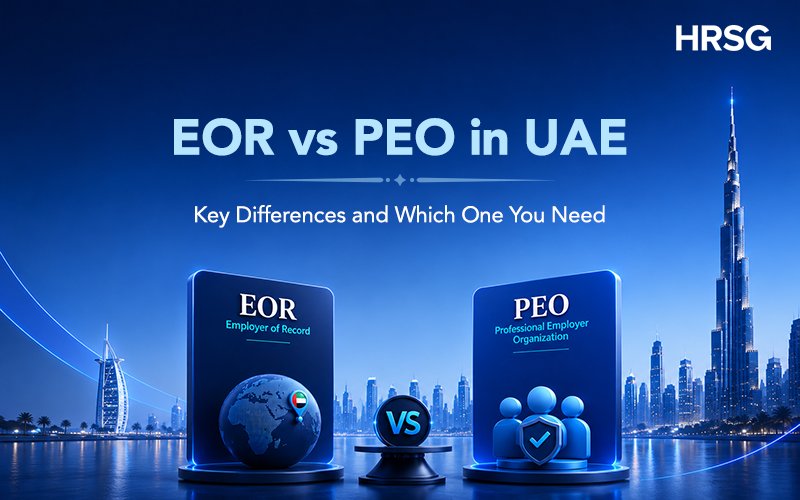
To run a successful operation in the UAE market businesses have to navigate intricate employment and compliance requirements. One decision that is particularly important is choosing between an Employer of Record (EOR) or a Professional Employer Organization (PEO) in the UAE.
An employer of record or EOR is basically the legal employer or owner of your workforce. This entity is responsible for employment compliance. A PEO on the other hand is an entity that shares HR responsibilities with your company. In this case the legal employer is still your company and not some third party.
Both EOR and PEO aim to simplify HR operations. However, their key objectives or the business needs they serve are different. This blog covers key differences between these two HR and recruitment services in the UAE to help you choose a suitable employment solution for your business in the UAE.
- EOR vs PEO in the UAE: A Quick Comparison
- What Is an Employer of Record (EOR)?
- What Is a Professional Employer Organization (PEO)?
- EOR vs PEO: Key Differences Between the Two
- EOR vs PEO: Which One Is Right for You?
EOR vs PEO in the UAE: A Quick Comparison
Both EOR and PEO aim to reduce the administrative burden of your organization. However, the legal nature or responsibilities of these services are not the same.
Here is a quick comparison to help you understand the difference between the two more clearly.
| Aspect | EOR | PEO |
| Legal Employer | EOR service is the legal employer. | Your business is the legal employer. |
| Payroll Management | EOR manages all aspects of the payroll. | PEO manages payroll on behalf of your business. |
| Employment Contracts | EOR issues the contract. | Your organization issues the contract. |
| Compliance Responsibility | The legal compliance is assumed by the EOR. | Your business and PEO share this responsibility. |
| Employee Visas | EOR handles the visa. | The employer has to handle the employment visa. |
| HR Administration | Your business fully outsources HR. | You share HR roles or responsibilities with the PEO. |
| Risk Management | The EOR assumes the employment risks. | The employer has to retain most of the legal risks. |
| Speed of Hiring | The hiring processes are very fast. | The hiring speed depends on your HR process efficiency or setup. |
| Employee Benefits | EOR manages these benefits. | PEO administers these benefits in most cases. |
What Is an Employer of Record (EOR)?
An EOR refers to a third-party organization that hires workers on behalf of some other business. EOR assumes all legal employment responsibilities. The businesses that work with EOR services manage the workload, performance, or objectives of the employees.
EOR’s biggest benefit is that you do not even have to establish a legal entity or a branch in the UAE before you can hire local employees. The EOR is mainly a legal employer of your workers who has to fulfill all employment or employee-related obligations according to the UAE labor laws 2026.
EOR services reduce the administrative burden as they can handle employment contracts and employment visas on behalf of your business. These organizations also take care of payroll processing, WPS (Wage Protection System) compliance, employee benefits administration, tax and statutory contributions (where applicable), labor law compliance, and employee onboarding and offboarding.
The EOR model works best in the following cases.
- When an international company wants to test the UAE market.
- Businesses that need to hire remote employees.
- Startups that expand quickly without local incorporation.
How it Works?
When you work with an EOR, you can identify candidates or decide on the roles and compensation. An EOR then hires the employees under its own UAE entity. They set up payroll, prepare employment contracts, take care of work permits and visa processing, and ensure ongoing compliance. This way the employee works exclusively for you while their legal employer remains the EOR.
Benefits of an EOR in the UAE
- An EOR allows businesses to hire new employees without spending any time on establishing a UAE business.
- With an EOR, you can hire employees in just a few weeks. There is no need to wait for company registration or licenses, which results in faster market entry.
- These HR business solutions EOR take care of compliance, non-compliance penalties, and employment disputes.
- EOR also helps your business with payroll management. It also takes care of your tax obligations.
- An EOR allows international businesses to hire UAE employees without an internal HR or legal team.
What Is a Professional Employer Organization (PEO)?
A PEO follows a co-employment model. In this case, your business remains the legal employer while the PEO you work with shares some of your HR roles. A PEO can help your business with payroll administration as well as HR support.
These services also take care of employee benefits, compliance guidance, recruitment support, performance management, HR documentation, and employee relations.
In the case of a PEO, your business is the legal employer. This means you, and not the company you work with, are responsible for compliance with the UAE labor laws.
Here is when this model works best.
- When you have a company that is already established in the UAE.
- The HR needs of your business are growing fast.
- You want to outsource HR processes to reduce the administrative burden.
How does it work?
A PEO does not handle every aspect of your HR. These services support your existing HR department to reduce the administrative burden. When working with a PEO, you are still in charge of hiring employees and signing employment contracts. In this case, you maintain legal employer status. This means you also have to handle employment liabilities as well as compliance.
Benefits of a PEO
- It reduces administrative burden by supporting your business in key HR tasks.
- PEOs help you create or negotiate competitive benefits packages when it comes to health insurance or retirement plans.
- You get access to specialists in HR to help with your operations without hiring an in-house team.
- PEOs offer more accurate payroll processes, which streamlines organization development.
- A PEO supports the growth of your business as it helps you manage your increasing workforce better.
EOR vs PEO: Key Differences Between the Two
Here are some key differences between EOR and PEO to help you better understand these concepts.
- Legal Employer
The EOR is the legal employer of the workforce on paper. This entity handles your employment contracts, government registrations, visa sponsorship, payroll compliance, labor law adherence, employee termination procedures, etc. In this case, your company only deals with the workload of the employees.
In the case of a PEO, your business is the legal employer. The PEO is just there to give you HR or administrative support. Your business, in this case, is responsible legally for employment obligations, employment contracts, regulatory compliance, employee sponsorship, corporate registrations, etc.
- Requirement for a UAE Entity
There is no need for you to set up a local legal entity if you go with EOR. The EOR’s registered entity is what you can use to hire a workforce.
With a PEO, you must have a registered UAE legal entity. This is because your company is the official employer in this case.
- Employment Contracts
EOR is what creates or issues the compliant employment contracts. They also have to manage all employment documentation.
PEO only offers administrative assistance. This means your business has to come up with employment contracts that comply with local laws.
- Speed of Hiring
EORs have an established legal presence in the UAE. This means they can help businesses onboard new employees within weeks or even a few days.
But with a PEO, you have to register a UAE business entity and obtain the necessary licenses. Businesses also have to complete government registrations and establish payroll systems. All of this must happen before you can hire new people. This makes the process much longer.
- Compliance Responsibility
To show employment compliance in the UAE, businesses have to take care of UAE Labour Law compliance, Wage Protection System (WPS), employment contracts, end-of-service gratuity, leave management, visa renewals, Emirates ID processing, health insurance requirements, and employee documentation.
In the case of an EOR, your business doesn’t have to spend any resources on these obligations. This not only reduces the administrative burden but also results in fewer legal risks.
With a PEO HR outsourcing, compliance is mainly the responsibility of your business. The PEOs only offer you guidance and limited administrative support. This makes compliance a shared responsibility in this case.
- Payroll Management
The EOR is what handles the processing of payroll. They also manage statutory payments or employee benefits, which reduces the administrative burden to a great extent.
With a PEO, the payroll management, its compliance, or disputes are all the responsibility of your business. The PEO only manages some aspects of the payroll or strategic HR planning on your behalf.
- Cost Comparison
EORs charge a fee per employee on a monthly basis. This fee includes the charges for payroll, compliance, HR administration, employment contracts, benefits management, and visa support. In this case, there are no costs linked to establishing or maintaining UAE entities.
With a PEO, the prices mainly include HR administration fees. Businesses have to pay extra for company formation, licensing, office spaces, legal compliance, government fees, and a robust payroll infrastructure. This makes it a less ideal option for businesses with a small workforce.
EOR vs PEO: Which One Is Right for You?
Before you choose between an EOR and a PEO, you need to consider your current business structure as well as your future expansion strategy.
-
EOR
Businesses without an established UAE entity who want to quickly expand their workforce can use an Employer of Record to avoid the complexity of company registration. This gives you a quicker market entry without any local incorporation. It also transfers the employment compliance responsibilities to a third party.
An EOR is a better choice if you wish to expand into the UAE market for the first time. It is also a good option when you need to hire employees quickly to test market demand before you can make a long-term investment.
-
PEO
On the other hand, businesses with established UAE entities who simply wish to reduce the administrative burden that comes with HR, salary, or payroll management can use a PEO. This will give you valuable administrative support while also ensuring you have more control over the workforce as a legal employer.
A PEO is a great option for your business if you already have an established workforce and you just need HR support to reduce management burden. Businesses whose internal HR department requires additional expertise can also use a PEO to streamline processes like payroll and benefits.
Conclusion
EOR and PEO both aim to help businesses with workforce management. However, these entities are suitable for different stages of the growth of your business. EORs are ideal for companies with no established legal entities in the UAE. This gives such companies faster and more compliant hiring and payroll management solutions.
PEOs are more effective for organizations that already have a local presence. They can help such organizations in streamlining HR processes without losing legal control over the workforce.
However, before you choose between the two, you need to consider your hiring volume, business expansion timeline, and long-term business goals. This can help you pick a solution that guarantees better operational efficiency and minimal compliance risks.
Visit us at HRSG today to get the best recruitment, HR, accounting, and payroll solutions for businesses of all sizes. Our dedicated teams can help you acquire and retain the top talent while ensuring full compliance with the current UAE labor laws.