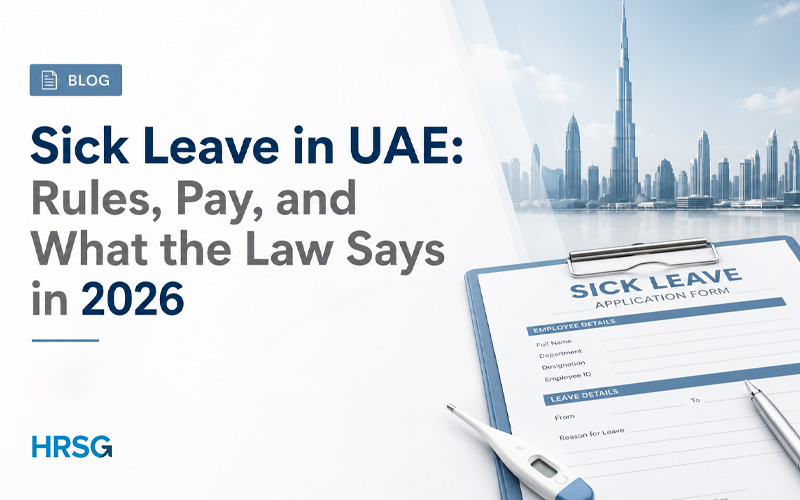
Every labor or employment law in the UAE aims to safeguard the rights of its workforce, especially when it comes to their health or well-being in general. For this purpose, the UAE government offers very relaxed sick leave regulations that ensure employees who are unable to work due to sudden health issues get the care they need.
Sick Leave in UAE (2026 — Federal Decree-Law No. 33 of 2021)
Under UAE Labour Law, employees in the private sector are entitled to 90 calendar days of sick leave per year, once the probation period is completed.
| Period | Days | Pay |
|---|---|---|
| First period | 15 days | Full pay |
| Second period | 30 days | Half pay |
| Third period | 45 days | No pay |
| Total | 90 days | Structured as above |
Key rules at a glance:
- Sick leave is counted in calendar days (not working days) — weekends and public holidays are included
- A medical certificate from a licensed UAE health authority is required
- Employees must notify the employer within 3 working days
- Sick leave during probation: not paid (employer may grant it voluntarily)
- Sick leave during notice period: permitted but unpaid beyond contractual obligations
- Sick leave is not carried forward to the next year — entitlement resets annually
- Sick leave cannot be cashed out on resignation or termination
- Employers cannot terminate an employee while on sick leave
Legal basis: Article 31, Federal Decree-Law No. 33 of 2021
There are clear legal provisions for sick leaves in the UAE employment laws and regulations. The framework for sick leaves is set forth by Federal Decree-Law No. 33 of 2021 on the Regulation of Labor Relations and its Executive Regulations.
These provisions establish the eligibility criteria for sick leave. They also outline the number of sick leaves and the salary policies in that period.
This blog covers all the ins and outs of sick leave in the UAE. So keep on reading till the end to make sure you do not violate any of these rules as an employee or an employer in the UAE.
- Understanding Sick Leave Under UAE Labor Law
- Eligibility Criteria for Sick Leave in the UAE
- Sick Leave Pay Policies in the UAE
- Additional Key Considerations for Sick Leaves According to UAE Laws
Understanding Sick Leave Under UAE Labor Law
Employees in the UAE are entitled to 90 calendar days of sick leave per year under Article 31 of Federal Decree-Law No. 33 of 2021. This is split into 15 days full pay, 30 days half pay, and 45 days without pay.
Sick leaves are a statutory employment benefit that aims to provide employees with health issues with some time away from work to recover. Employees become eligible for this leave if they face unexpected medical conditions that limit them physically or mentally.
Official UAE government sources state that every employee gets up to 90 calendar days of sick leave every year either continuously or intermittently. To become eligible for this leave however they must complete a probation period. Once the employee gets this leave through a proper channel they can get some paid time off from work to better recuperate.
One key thing to note is that the employee gets this leave according to calendar days and not working days. This means every public holiday or weekend that falls in the sick leave holidays is a part of the calculations.
Employees have the freedom to either take sick leaves in one continuous period or in intermittent fashion if they get ill more than once a year.
The sick leave policies in the UAE give you a structured framework that clearly covers the number of leaves and the salary entitlements. This aims to reduce uncertainty for every party involved.
Eligibility Criteria for Sick Leave in the UAE
The statutory sick leave provisions that the UAE’s labor laws state apply to all employees who work in the private sector. However, to be eligible for sick leave, the employee must be a part of a full-time employment contract.
In some cases, employees with part-time contracts can also get this leave, but in this case, the decision is subject to applicable regulations.
Employees with fixed-term employment contracts or flexible work arrangements where labor law applies can also get sick leave in the UAE. The leave framework may be a little different for government employees or those who are a part of certain free zone organizations.
These employees need to look into their own company’s sick leave policies to determine whether they follow federal labor laws or have their own employment regulations.
Here are some key points that highlight the eligibility criteria for sick leave in the UAE.
- Employees become eligible for this leave after they successfully complete the probation period with the company.
- Employers can voluntarily allow medical or sick leave if the employee is still in the probation period.
- Employers may voluntarily provide paid or unpaid medical leave during probation through internal policies.
- Employees must notify the employer about the leave within three working days.
- They also need to provide a medical report to become eligible.
- Several private or multinational organizations can choose to provide more generous sick leave benefits for their employees after due consideration.
- According to UAE labor laws, employees cannot get paid sick leave if their illness is the result of substance abuse, misconduct, or deliberate violation of work safety protocols.
Sick Leave Pay Policies in the UAE
Many new employees in the UAE have no idea about sick leave salary policies in the UAE. They assume that after the leave approval, they can get paid leave for the full 90 days. However, this is not the case.
Here is what the UAE labor law says in this regard. Employees are eligible for full pay for the first 15 days, half pay for the next 30 days, and no pay for the remaining 45 days of sick leave in the UAE.
The purpose of this salary structure is to support sick employees during this tough time while keeping some of the financial burden off the shoulders of the employers at the same time.
This structure encourages employee protection while also helping employers manage long-term workforce costs.
Employees who are also required to work on weekends or public holidays may be entitled to additional time off — learn how compensatory off leave works in the UAE and what the law requires employers to provide.
Additional Key Considerations for Sick Leaves According to UAE Laws
Here are some additional key regulations that both employers and employees must keep in mind when it comes to sick leaves in the UAE.
-
Mandatory Medical Certificate
Every employee who needs to apply for sick leave must obtain a medical certificate from licensed healthcare centers in the UAE. This certificate should mention the employee’s details along with the date of examination.
Another key thing on this certificate is the diagnosis and the leave period that the doctor recommends. You can submit this certificate through the recruitment and human resources services in the UAE that your company works with, or to the internal leave management system.
-
Reporting Your Illness
Another important thing is to report to the employer in a timely manner. For this purpose, you can either inform your HR or call the manager to whom you report on a regular basis.
You can inform them about the recovery time and submit the medical certificate promptly to avoid disputes.
-
Medical Certificate Verification
As an employer, if you have concerns about the authenticity of the medical certificate, you can verify it through lawful procedures. If an employee submits a fraudulent medical certificate, it can result in disciplinary actions or even termination of the employment contract.
Can You Take Sick Leave Without a Medical Certificate in UAE?
Under UAE Labour Law, a valid medical certificate from a licensed healthcare provider is a mandatory requirement to claim sick leave. Without it:
- The employer has the right to treat the absence as unauthorized leave
- The employer can deduct the corresponding days from annual leave
- In cases of repeated absence without documentation, disciplinary action may follow
- The employer can legally reject the sick leave request
The only exception is if the employer has a more lenient internal policy that allows 1–2 days of sick leave without a medical report. However, this is at the employer’s sole discretion and is not guaranteed by law.
Always obtain a medical certificate from a DHA-licensed clinic, hospital, or government health center to protect your right to sick leave pay.
-
Sick Leave Rejection
If the employee submits an application for sick leave and they follow all the internal as well as external labor law requirements, then the employer has no grounds to reject the sick leave.
The rejection is only possible when the employee doesn’t provide the certificate, or they give you fraudulent documents along with the leave application.
-
Long-Term Illness and Extended Medical Leave
If an employee needs several months of leave due to major medical procedures like cancer treatment or organ transplants, they can first exhaust the 90-day leave and then ask the employee for further relaxation. Employers can grant this leave after considering their company policy or other applicable legal provisions.
-
Termination While on Sick Leave
Employers cannot terminate the employment contract while the employee is on sick leave. However, if the statutory leave duration ends but the employee is still not able to show up for work, the employer has the right to end the contract according to the Labor Laws of the UAE.
The termination of the contract does not result in the forfeiture of end-of-service benefits, unpaid leaves, or accrued leaves.
-
Sick Leave During Probation
If you are on probation in the UAE, the sick leave policies do not apply in general. However, there are some cases where, if the employer wants, they can grant paid or unpaid sick leave to the employees on probation.
So if you are a new employee who is on a probation period, it is better to either discuss this possibility with the employer or to look at your employment contract for this information.
-
Sick Leave During Notice Period in UAE
If an employee has already resigned and is serving their notice period, they can still fall ill. Here is what the law says:
- Employees can take sick leave during the notice period
- Sick leave taken during the notice period does not extend the notice period
- Pay entitlements still apply: full pay for the first 15 days, half pay for days 16–45
- If the illness prevents the employee from completing the notice, the employer may choose to waive the remaining notice period
- Employees cannot use sick leave to avoid serving notice or to extend final settlement timelines
Always review your employment contract, as some companies have internal policies that provide additional provisions for sick leave during the notice period.
-
Sick Leave and Public Holidays
Since UAE sick leave is calculated in calendar days and not working days, public holidays and weekends that fall within an approved sick leave period are counted as part of the sick leave. They do not add extra days to the entitlement.
For example: If an employee takes 10 days of sick leave and 2 public holidays fall within that period, the total deducted from their 90-day entitlement is still 10 days.
-
Does Sick Leave Renew Every Year in UAE?
Yes. The 90-day sick leave entitlement under UAE Labour Law is an annual entitlement — it resets at the start of each employment year. Unused sick leave from one year does not carry forward to the next. Unlike annual leave, sick leave cannot be accumulated, converted to cash, or paid out upon termination or resignation. Employees who do not use their sick leave in a given year simply lose that entitlement for that year.
-
Is Sick Leave Paid Out on Termination or Resignation in UAE?
No. Unlike annual leave, sick leave cannot be encashed or paid out at the end of employment. If an employee resigns or is terminated, any unused sick leave days are forfeited. They do not form part of the end-of-service gratuity calculation.
However, if an employee was on approved sick leave at the time of termination, all dues owed during the sick leave period (full pay / half pay as applicable) must be settled as part of the final settlement.
-
Responsibilities of Employers and Employees
- Employees
As an employee, you must act honestly when you apply for sick leave in the UAE. The labor laws in the region are strict about medical certifications and the reporting procedures for sick leave. This is why you need to make sure you cooperate with the employer’s requests for lawful documentation. And once you become medically fit, you must return to work immediately, as delaying any further can lead to conflicts down the line.
- Employers
As an employer, you need to maintain a written sick leave policy in your HR policies and procedures in the UAE. You also need to process the leave requests quickly and fairly. It is also your responsibility to pay the employees what they are due while on leave. And finally, you need to try to keep the medical records of each employee confidential and avoid discriminatory treatment.
Conclusion
The UAE’s labor laws give a clear framework for sick leave that protects both the rights of the employees and employers. Every employee who is medically unfit to do their job due to some health issue gets about 90 sick leaves per year.
Out of these leaves, about 15 are fully paid, while 30 are half paid. The remaining 45 are unpaid leaves. Employees in the probation period are not eligible for these leaves. Moreover, employees who need these leaves have to submit a timely medical certificate to the company to get approval.
It is important both for employees and employers to learn all there is about sick leave policies in the region. This can help them avoid practices that lead to operational disruptions or contractual disputes down the line.
Visit us at HRSG today to learn more about leave policies in the UAE. We also specialize in HR, recruitment, payroll, and other key people solutions for businesses in the UAE and beyond.
-
Frequently Asked Questions: Sick Leave in UAE
How many sick leaves are allowed in UAE per year?
Employees in the UAE private sector are entitled to 90 calendar days of sick leave per year. The first 15 days are fully paid, the next 30 days are half paid, and the remaining 45 days are unpaid.
Can I take sick leave during probation period in UAE?
No. During the probation period, employees are not entitled to paid sick leave under UAE Labour Law. However, an employer may voluntarily grant paid or unpaid sick leave during probation at their discretion. A valid medical certificate is still required.
Can I take sick leave during my notice period in UAE?
Yes, sick leave is permitted during the notice period. However, it does not extend the notice period, and sick leave pay rules still apply based on your cumulative usage that year.
Does sick leave renew every year in UAE?
Yes. The 90-day sick leave entitlement resets each employment year. Unused sick leave cannot be carried forward, accumulated, or cashed out.
Can an employer reject sick leave in UAE?
An employer can reject sick leave if the employee fails to provide a valid medical certificate, submits a fraudulent document, or does not notify the employer within 3 working days of falling ill. If all legal requirements are met, the employer cannot reject the leave.
Do I need a medical certificate for sick leave in UAE?
Yes. A medical certificate from a licensed UAE healthcare provider is mandatory for sick leave to be approved and paid. Without it, the employer can treat the absence as unauthorized.
What happens if sick leave falls on a public holiday in UAE?
Public holidays and weekends falling within an approved sick leave period are counted as part of the 90-day entitlement, since sick leave is calculated in calendar days, not working days.
Is sick leave paid out on resignation in UAE?
No. Unlike annual leave, unused sick leave is not paid out upon resignation or termination. Only accrued annual leave is encashable at the time of final settlement.
Can an employer terminate an employee on sick leave?
No. Employers cannot terminate an employee during an approved sick leave period. However, once the 90-day entitlement is exhausted and the employee still cannot return to work, the employer may terminate the contract as per UAE Labour Law.
What is the new sick leave law 2026 in UAE?
There are no major amendments to the sick leave law in 2026. The current framework remains under Federal Decree-Law No. 33 of 2021 (Article 31): 90 days per year — 15 days full pay, 30 days half pay, 45 days unpaid. Employers and employees are advised to monitor MoHRE circulars for any updates.