4.1%
UAE Avg Salary Increase 2026
1.8%
UAE Inflation Forecast 2026
60–70%
Base Salary of Total Package
30–40%
Allowances of Total Package
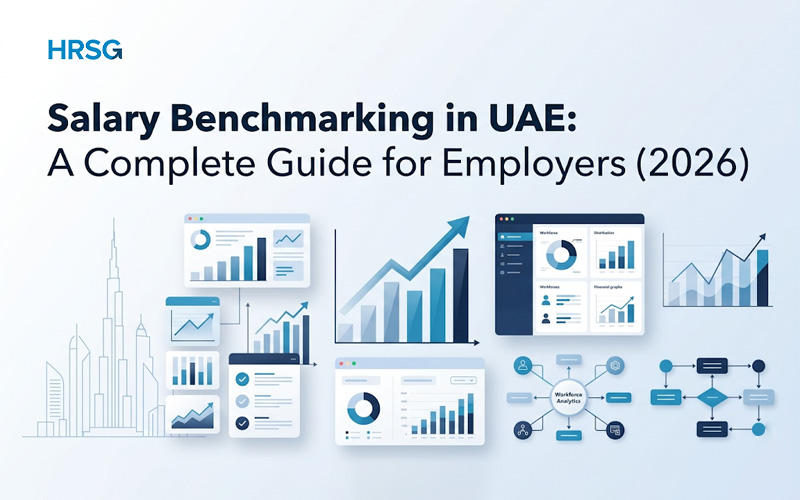
Salary benchmarking in the UAE has become one of the most critical tools for employers trying to attract and retain skilled talent in one of the world’s most competitive job markets. Whether you’re reviewing compensation for existing staff or setting pay for a new hire, getting it right requires more than gut feel — it requires structured, data-driven benchmarking against current UAE market standards.
This guide covers everything UAE employers need to know about salary benchmarking in 2026: what it is, its key components, why it matters in the UAE context, best practices, indicative salary ranges by function, and the most common mistakes to avoid.
- What Is Salary Benchmarking?
- Key Components of UAE Salary Benchmarking
- Why Salary Benchmarking is Important for Employers in UAE (2026)
- Salary Benchmarking in the UAE: Best Practices for Employers
- Common Salary Benchmarking Mistakes to Avoid

What Is Salary Benchmarking?
Salary benchmarking is a process where a business compares the pay rate of its company for different roles against the prevailing market or competitor pay rates. The main goal of this practice is to guarantee an organization offers fair but competitive packages to attract top talent and to retain existing employees without exceeding their budget.
In salary benchmarking businesses look at their company’s compensation packages to make sure they are comparable with the current market rates for similar roles, industries, experience levels, and locations.
In the UAE’s competitive market salary benchmarking is particularly important as the salary or benefit structures vary significantly between employers in the region. This means employers have to evaluate their entire value proposition periodically and not just the base or monthly salary figures to show payroll compliance in the UAE.
Key Components of UAE Salary Benchmarking
This section lists the main components of salary benchmarking that a business needs to take into account.
- Base Salary
This is the fixed amount that businesses offer to their employees each month. It does not include additional benefits of bonuses. The exact base salary depends on industry standards, skill level, company size, revenue impact, and market demand.
Underpaying base salary leads to offer rejections and employee dissatisfaction. On the other hand, paying more than the base salary benchmark creates payroll sustainability issues down the line.
- Allowances
This is additional compensation which includes housing, mobile, education, transportation, airfare, and relocation allowance. Businesses that offer these additional benefits do well in terms of employee satisfaction or retention, even with relatively lower base salaries.
- Bonuses and Variable Pay
Organizations use bonuses or performance incentives to drive productivity, increase retention, and align employee goals with business outcomes. The purpose of bonuses or variable pay is to reward the employees for their performance or impact rather than just their role.
- End-of-Service Benefits
UAE labor laws also require every employer to provide competitive end-of-service gratuity benefits to eligible employees. Thus to better benchmark salaries employers need to take into account things like gratuity liabilities, employee tenure trends, and long-term workforce costs. Businesses that integrate this into their financial forecasting or workforce budgeting can ensure there are no compliance issues down the line.
- Non-Monetary Benefits
Flexible work, hybrid policies, paid certifications, and mental health support are increasingly part of the total compensation picture in the UAE. While these don’t appear on a payslip, they influence offer acceptance and retention, particularly among mid-to-senior professionals.
UAE Salary Ranges by Seniority Level (Monthly Base, AED)
Add this as a new H2 section titled “UAE Salary Ranges by Level (2026)”, placed immediately after the intro, before Key Components:
| Seniority Level | Monthly Base Salary (AED) |
|---|---|
| Entry-Level (0–3 yrs) | AED 8,000 – 15,000 |
| Mid-Level (4–7 yrs) | AED 18,000 – 35,000 |
| Senior-Level (8–12 yrs) | AED 35,000 – 80,000 |
| C-Suite / Executive | AED 85,000 – 200,000+ |
Figures reflect monthly base salary only. Total compensation including housing, transport, and other allowances typically adds 30–40% to these figures.
Key Sector Benchmarks (2026)
Add this as a sub-table immediately below the one above, under the same section:
| Role | Monthly Base Salary (AED) |
|---|---|
| AI / ML Engineer | AED 36,000 – 54,000 |
| Software Engineer | AED 28,000 – 40,000 |
| Financial Analyst (Mid-level) | AED 14,000 – 20,000 |
| HR Manager (Mid-level) | AED 21,000 – 28,000 |
| HR Director | AED 47,000 – 85,000 |
| Legal & Compliance Manager | AED 25,000 – 45,000 |
| Construction Project Manager | AED 22,000 – 30,000 |
| Cybersecurity Architect | AED 37,000 – 56,000 |
Sources: CBUAE Economic Review 2025–2026, GCC market compensation surveys, HRSG internal benchmarking data.
UAE Compensation Structure: Base vs. Allowances
Total compensation packages in the UAE are typically structured as 60–70% base salary and 30–40% allowances. Always benchmark total cash — not base salary alone — to get an accurate picture of market competitiveness.
Common allowances include housing (most prevalent at ~94% of employers), transport (~80%), mobile (~75%), education (~52%), and annual airfare (~65%). Health insurance is mandatory and provided by over 90% of UAE employers.
Why Salary Benchmarking is Important for Employers in UAE (2026)
Now that you know the basics of salary benchmarking, you might be wondering, why exactly is there a need to benchmark salaries as an employer in the UAE. Here are some points that answer this important question.
- Talent Competition Is Intensifying
The UAE is the world’s top talent destination. Some of the most distinguished names in sectors like AI, finance, healthcare, and construction arrive here to advance their careers.
These professionals prefer this region for its tax-free salaries and business-friendly environment.
But as more talent enters the UAE to meet the high demand, it creates talent acquisition challenges for payroll and HR compliance services in the UAE. One way to make sure you attract these professionals is to make sure you offer fair, competitive salaries, and this is not possible without salary benchmarking.
- Employees Are More Informed
The workforce in the UAE now has more knowledge about the current salary or compensation trends in their industries. Professionals have access to LinkedIn salary insights, recruitment salary guides, Glassdoor reviews, and professional communities. This helps them evaluate their salaries based on real-time data. This means businesses have to focus more on salary benchmarking to retain employees and maintain their reputation.
- The Cost of Living Is Rising
The cost of living in major Emirates like Abu Dhabi or Dubai is on the rise. Factors like higher rental costs, increased transportation expenses, utility inflation, and healthcare costs urge employees to pursue organizations with higher salaries.
To meet these high salary expectations, businesses need to focus on salary benchmarking that takes these rising costs into account.
- Emiratisation Is Influencing Compensation Structures
The UAE government’s Emiratisation initiatives focus on increasing private-sector employment opportunities for locals. Every employee has to restructure their compensation strategy to make sure they meet Emiratisation targets.
The compensation packages must be modified to attract Emirati talent and to remain compliant with labor regulations. Salary benchmarking has thus become a key element of broader workforce strategy and compliance planning in the UAE.
Salary Benchmarking in the UAE: Best Practices for Employers
An effective salary benchmarking strategy involves several key steps. This section takes you through each of them to help you stay on top of everything.
- Define Comparable Roles
As an employer you need to compare the actual role or responsibilities of each employee with your competitors. For example, a manager for one company might be someone who is in charge of day-to-day stuff or a small team.
For another business, the manager might be someone who is involved in regional leadership or branch matters. This means that considering only the title is not enough for accurate salary benchmarking.
You need to consider the scope of responsibilities and revenue contribution along with leadership expectations to determine an accurate salary.
- Collect Reliable Market Data
The next step is to gather reliable market data regarding salary benchmarks from sources like accounting and bookkeeping services, recruitment firms, market trends, exit interview data, industry networks, and competitor intelligence. Make sure to combine the external market data with internal workforce analytics to better benchmark salaries without errors.
- Benchmark Against Market Percentiles
This approach allows you to compare the salary you offer with the broader job market.
- If your salary stands at the 25th percentile, it indicates that about 75% professionals in the same role earn more than what you offer.
- The 50th Percentile indicates the market median. This shows 50% of professionals earn more and 50% earn less than what you offer.
- The 75th Percentile shows you offer above-average market pay. This means only about 25% professional make more than what you offer for a similar role.
- 90th Percentile indicates a premium compensation level. This means 90% of the professionals in similar roles make less than what you offer.
- Analyze Internal Pay Equity
Better salary benchmarking is also about internal compensation fairness. Poor internal pay equity can lead to employee resentment, low trust in the leadership, and reduced engagement.
To prevent this, you need to work on role-pay consistency and gender pay gaps. You also need to eliminate departmental disparities. This creates a better company culture where every employee is treated fairly.
- Build a Sustainable Compensation Strategy
The main goal of your salary benchmarking strategy is to ensure long-term compensation planning. You need to put in place salary bands and frameworks for promotions, annual increments, bonuses, and benefits.
This helps businesses balance talent competitiveness with business profitability as well as long-term growth goals.
- Conduct Annual Salary Benchmarking Reviews
Businesses in the UAE need to conduct salary benchmarking reviews every year. This allows them to stay competitive, plan budgets better, and control turnover in response to the rapidly shifting market. Experts suggest this review every 6 months for businesses in high-growth sectors.
- Prioritize Employee Communication
And last but not least transparent employee communication in terms of salary review processes, promotion criteria, and bonus policies is also integral to salary benchmarking strategies. This practice ensures there is no distrust among your workforce, which fosters better collaboration and retention.
Common Salary Benchmarking Mistakes to Avoid
Many businesses that are new to salary benchmarking make common mistakes that cost them dearly in terms of employee trust, retention, and overall budget. Here are some key mistakes that you must avoid when benchmarking salaries.
- The use of outdated data that doesn’t reflect current marketing conditions for salary benchmarking.
- Only using base salary to benchmark compensation without considering additional benefits is also a huge mistake.
- Making a decision based only on job titles instead of considering actual responsibilities.
- Ignoring free zone vs mainland compensation differences is also a major mistake.
- Conducting salary reviews infrequently as the market continusouly changes in the UAE.
- Businesses also fail to align their compensation strategies with Emiratisation requirements.
- It is also a mistake to offer aggressive salaries with no payroll sustainability planning in the long run.
- Another big mistake is when you consider salary benchmarking as a one-time exercise instead of an ongoing practice.
Conclusion
Salary benchmarking is an important tool in 2026 that can help businesses in the UAE better understand market salary trends and offer compensation accurately. This practice maintains internal fairness and helps businesses adapt quickly to workforce expectations.
Data-driven salary benchmarking is what allows businesses to reduce turnover and attract top talent. It also fosters more trust in the management, which results in better workforce stability.
This means salary benchmarking is not just optional in the UAE. Instead, it is an essential tool that gives businesses a competitive edge when it comes to talent acquisition and ensures sustainable long-term growth.
Visit HRSG today to get the best financing, accounting, and salary benchmarking solutions to ensure compliance and guarantee competitive employee compensation for all types of businesses in the UAE.
Our experts in payroll and compliance services can ensure every employer is able to stay on top of the latest changes in salary benchmarking practices and rules to avoid making major financial errors.
FAQs
What is a good salary in the UAE in 2026?
Entry-level professionals in the UAE earn AED 8,000–15,000 per month in base salary. Mid-level professionals earn AED 18,000–35,000, senior-level professionals AED 35,000–80,000, and C-suite executives AED 85,000–200,000+. These figures exclude allowances, which add a further 30–40% to total package value.
What is the average salary increase in the UAE in 2026?
The projected average salary increase in the UAE for 2026 is 4.1%, following an actual 4.2% in 2025. With UAE inflation forecast at 1.8% (CBUAE), employees receiving this increase can expect approximately 2.3% real wage growth.
Does UAE salary benchmarking include allowances?
Yes — always benchmark total cash, not base salary alone. Most UAE employers structure packages as 60–70% base salary and 30–40% allowances (housing, transport, education, airfare). Comparing base salaries only gives an incomplete picture of market competitiveness.
Which sectors have the highest salaries in the UAE in 2026?
Banking and financial services lead, with wealth management and fintech roles commanding 10–15% premiums. AI and cybersecurity roles are seeing 8–10% salary growth. Other high-paying sectors include oil and gas, real estate, and healthcare.
How often should UAE companies benchmark salaries?
At minimum, annually. For high-demand roles in AI, cybersecurity, fintech, and banking, every six months is recommended as these markets move faster than annual review cycles.
What is the consequence of inaccurate salary benchmarking in the UAE?
Inaccurate salary benchmarking can lead to serious business risks including high employee turnover, failed talent acquisition, and internal pay equity disputes. Underpaying relative to the market makes it harder to retain skilled staff, while overpaying without a structured framework puts long-term payroll sustainability at risk. For businesses with Emiratisation obligations, misaligned compensation can also result in non-compliance with NAFIS quota targets, which carry financial penalties.