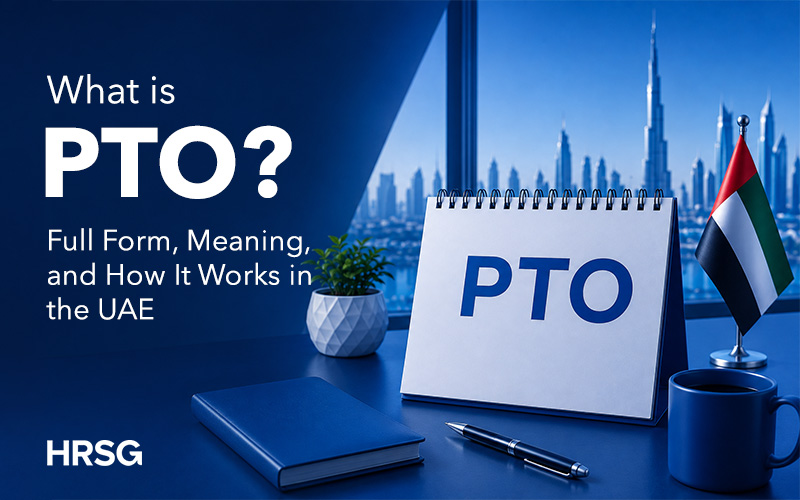
PTO is one of those workplace terms that gets used a lot, but not everyone is sure what it means. You might have seen it on a job offer or an HR portal and wondered what exactly it covers here in the UAE.
PTO simply stands for Paid Time Off. It is the time an employee can take away from work while still getting their salary. But here is the catch. The way PTO works in the UAE is not the same as in countries like the US.
In the UAE, paid time off is not one single leave balance that you dip into for any reason. It is a set of separate leaves, each with its own rules and pay, all set by Federal Decree-Law No. 33 of 2021.
This blog covers all the ins and outs of PTO in the UAE. So keep on reading till the end.
- What Is PTO? Full Form and Meaning
- How PTO Works in the UAE
- Types of Paid Time Off (PTO) in the UAE
- How PTO Pay Is Calculated in the UAE
- Key Considerations for Employers and Employees
What Is PTO? Full Form and Meaning
The full form of PTO is Paid Time Off. It is an umbrella term for any time an employee takes away from work while still getting paid. This means the employee does not lose their salary for the days they are on approved leave.
In many countries, PTO is a single pool of days that employees can use for any reason, whether it is a vacation, an illness, or a personal errand. The employee simply draws from this one balance.
The UAE, however, does not follow this single-pool model. Here, paid time off is what the labor law divides into separate, clearly defined leave types. Each type has its own eligibility rules, its own number of days, and its own pay policy.
So when we talk about PTO in the UAE, we are really talking about the collection of statutory leaves that every eligible employee is entitled to under the law.
How PTO Works in the UAE
In the UAE, paid time off works through the leave entitlements set out in the labor law. Every private-sector employee who meets the eligibility criteria can use these leaves without losing their pay.
The statutory leaves apply to employees who work under a full-time employment contract in the private sector. Employees on part-time, flexible, or fixed-term contracts may also be eligible, but in this case, the entitlement is subject to applicable regulations.
Another thing to keep in mind is that most leaves are tied to how long you have been with the company. So the longer you stay, the more leave you end up with.
Government employees and those in certain free zones may follow slightly different rules. These employees need to look into their own organization’s policies to determine whether they follow federal labor laws or have their own leave policies in the UAE.
Employers are free to offer more generous paid time off than the law requires. Many private and multinational organizations choose to provide extra leave days as part of their benefits package to attract and retain top talent.
Types of Paid Time Off (PTO) in the UAE
Here are the main types of paid time off that employees in the UAE are entitled to under the labor law.
-
Annual Leave
Annual leave is what most people think of as vacation time. Employees who complete one year of service are entitled to 30 calendar days of paid annual leave every year.
Employees who have completed six months but not a full year get two days of leave for each month of service. During the first six months of employment, there is no statutory annual leave entitlement.
-
Sick Leave
Employees can get up to 90 calendar days of sick leave in the UAE every year once they complete their probation period. However, this leave is not fully paid for the entire duration.
The pay is structured in three parts. Employees get full pay for the first 15 days, half pay for the next 30 days, and no pay for the remaining 45 days. To become eligible, the employee must notify the employer and submit a valid medical certificate.
-
Maternity Leave
Female employees in the private sector are entitled to 60 days of maternity leave. Out of these, the first 45 days are fully paid, while the next 15 days are paid at half salary.
In some cases, the mother can take additional unpaid leave if she or her child faces a medical condition as a result of the pregnancy or childbirth.
-
Parental Leave
The UAE was one of the first countries in the region to introduce parental leave. Both parents, whether the mother or the father, are entitled to five working days of paid parental leave. This leave can be taken within the first six months from the date of the child’s birth.
-
Public Holidays
Employees in the UAE also get paid days off on the official public holidays announced by the government. And if you do end up working on one of these days, your employer has to make up for it, either with extra pay or a day off later.
-
Other Paid Leaves
There are a few other leaves worth knowing about too. Employees can take bereavement leave if a close family member passes away. There is also study leave for those enrolled in a UAE university, and a one-time leave to perform Hajj. How many days you get, and whether they are paid, depends on the conditions the law sets for each one.
How PTO Pay Is Calculated in the UAE
The pay during paid time off depends on the type of leave the employee takes. This is an area where many new employees in the UAE get confused, so it is worth understanding clearly.
Annual leave is paid at the employee’s full wage, which covers the basic salary plus any regular allowances. Sick leave works differently. Here, the pay drops in stages, from full pay to half pay and then to nothing, based on how many days are taken. Maternity leave falls somewhere in between, with full pay for the first 45 days and half pay for the next 15.
The idea behind these pay rules is fairly simple. The point is to tide employees over financially while they are off, but not at a cost the business cannot carry. And because the split is spelled out from the start, nobody is left guessing, which is usually where pay disputes begin.
Key Considerations for Employers and Employees
A couple of smaller details tend to get overlooked, so they are worth a quick word here, for employers and employees alike.
-
For Employers
If you are the employer, the starting point is a clear leave policy written into your HR policies and procedures in the UAE. From there it comes down to the basics. Approve leave requests fairly, do not sit on them, and pay people the right amount for the days they are off. Keeping a record of who has taken what saves you headaches too, since it is easy to lose track otherwise. This is exactly the kind of thing a decent HR and payroll system handles for you.
-
For Employees
As an employee, the main thing is to apply for your leave the proper way and give your employer a heads-up in good time. If it is sick leave, you will also need to hand in a valid medical certificate without dragging it out. And when your leave is over, try to get back to work on time so you do not run into friction with your employer.
-
Unused Leave and Final Settlement
One more thing people often forget is what happens to leave they never used. If you leave the company or your contract comes to an end, you get paid out for any annual leave days you did not take. That payment is rolled into your final settlement, along with your other end-of-service dues.
Conclusion
Paid time off, or PTO, is simply the paid leave that employees are entitled to while they are away from work. In the UAE, this is not a single leave balance but a set of clearly defined leaves that the labor law protects, including annual leave, sick leave, maternity leave, parental leave, and public holidays.
Every one of these leaves comes with its own eligibility rules and pay structure. This is why it is important both for employers and employees to understand how paid time off works in the region. Getting familiar with these rules now can save you a lot of avoidable disputes and compliance headaches later on.
For the full picture, take a look at our detailed guide to the UAE labor laws.
Visit us at HRSG today if you want a hand with leave management or HR compliance in the UAE. Alongside that, we handle recruitment, payroll, and other people solutions that businesses of every size rely on, both in the UAE and beyond.