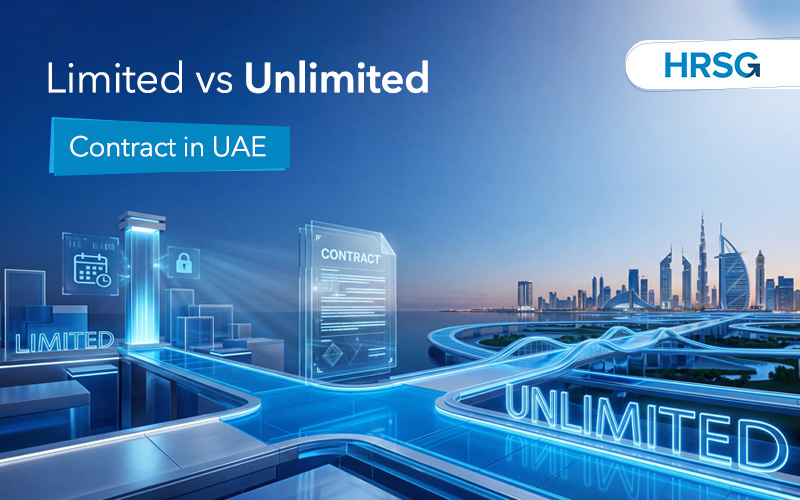
When securing a job in the UAE or any other part of the world, for that matter, employees are usually presented with either a limited contract or an unlimited contract from their employers.
Limited vs Unlimited Contract in UAE (2026)
Since February 2, 2022, unlimited contracts have been abolished in the UAE private sector under Federal Decree-Law No. 33 of 2021. All private sector employees now work under limited (fixed-term) contracts. If you were previously on an unlimited contract, it should have been converted to a limited contract by December 31, 2023.
| Feature | Limited Contract | Unlimited Contract |
|---|---|---|
| Fixed end date | Yes | No |
| Auto-expiry | Yes | No |
| Renewal required | Yes | No |
| Notice period | 30–90 days | 30–90 days |
| Early termination by employer | Compensation payable | Legal grounds + notice required |
| Resignation before expiry | Notice period + contractual terms | Notice period required |
| Gratuity eligibility | After 1 year of service | After 1 year of service |
| Currently allowed in UAE private sector | Mandatory | Abolished since Feb 2022 |
Legal basis: Federal Decree-Law No. 33 of 2021, Article 8
As an employee looking for career opportunities in the UAE, it is extremely important that you know the nature of the contract you are getting into. This directly affects your job responsibilities, termination rules, compensation, and other rights.
In the UAE, however, the recent law, particularly the Federal Decree-Law No. 33 of 2021, which came into effect on 2 February 2022, have abolished unlimited contracts in the private sector. This means every private sector business under the Ministry of Human Resources and Emiratization (MoHRE) has to operate under fixed-term or limited employment contracts.
This blog looks into limited vs unlimited contracts in the UAE in detail. It highlights what these contracts are, how they differ, and why the new laws abolished unlimited contracts in the country. So, let’s get into it.
- What is an Employment Contract in the UAE?
- What is a Limited Contract?
- What is an Unlimited Contract?
- Limited vs Unlimited Contract in the UAE: Major Differences
- Recent Change in the Law: Abolishment of Unlimited Contracts in the UAE
What is an Employment Contract in the UAE?
Employment contracts are legally binding agreements that clearly state the rights and obligations of both the employee and the employer. This document provides the foundations for the working relationship between the employer and the employees under the UAE employment laws and regulations. The main goal of this contract is to ensure legal compliance while protecting both parties in case disputes arise.
A typical employee contract contains the following information.
- Names and contact information of both parties
- Job title and roles or responsibilities
- Salary, compensation, and benefits
- Location and working hours
- Leave entitlements
- Probation period
- Notice period
- Contract duration
- Termination conditions
- Confidentiality clauses (in some cases)
The previous UAE Labor Laws, specifically the Federal Law No. 8 of 1980, allowed employers to choose between limited and unlimited contracts. However, the new law forbids unlimited contracts in the private sector.
What is a Limited Contract?
A limited contract or a fixed-term contract is an agreement between an employee and a business with a fixed start and end date. This contract clearly defines the duration of employment and expires automatically once this duration is over. At the end of the contract, both parties can agree to renew the contract.
According to professional recruitment and HR services in the UAE, in case of early termination in a limited contract, businesses have to compensate the employees in terms of salary or benefits. This contract mostly works for project-based or time-specific roles.
For employers, this contract ensures more certainty regarding workforce planning and easier management of project-specific employees, along with predictable contract expiry dates.
For employees, the limited contract offers clear working durations, defined contractual terms and benefits, and greater certainty regarding contractual commitments. However, it comes with potential restrictions on early resignations and less job security at the end of the contract.
What is an Unlimited Contract?
As the name suggests, the type of contract doesn’t come with a fixed end date. The employment can continue until either the employee or the employer wants to terminate the relationship, keeping in mind the applicable notice requirements.
An unlimited contract does not have a predetermined end date. Employment continues until either party decides to terminate the relationship according to the applicable notice requirements.
This contract ensures greater termination or resignation flexibility while creating a stable ongoing employment relationship. This contract was widely used in the private sector in the UAE before 2022.
An unlimited contract leads to better job security if the employee delivers expected outcomes. This results in long-term employment continuity as well. This contract allows employers to retain employees indefinitely and reduces the administrative burden of contract renewals. However, in this case, termination or resignation disputes can become quite complex.
Limited vs Unlimited Contract in the UAE: Major Differences
Let’s take a closer look at the key differences between limited and unlimited contracts in the UAE to give you a better idea.
- Contract Duration
Limited contracts have a specific and previously agreed-upon end date. This contract automatically expires when the duration ends. An unlimited contract, on the other hand, has no fixed end date. It can go on until either the employees or the employer decides on termination.
- Termination Rules
In case of a limited contract, the employer cannot terminate its employees during the contract’s duration unless they have a valid reason for it. In case of termination before the expiry date, compensation is payable to the employees. Employees who resign before the expiration date are also subject to penalties.
Unlimited Contract Termination: Rules That Applied Before 2022
For employees who were on unlimited contracts before the 2022 abolishment, the following termination rules applied — this is relevant if you are still resolving a legacy dispute or calculating historic gratuity:
- Employer termination without cause: Employer had to provide a notice period (30–90 days) and pay compensation. Arbitrary dismissal without valid reason entitled the employee to 3 months’ compensation.
- Employee resignation: The employee had to give notice. Gratuity was reduced depending on years of service (see gratuity table above).
- Mutual agreement: Both parties could terminate by mutual consent at any time.
- Gross misconduct: Employers could terminate without notice or gratuity in defined circumstances under Article 44 of the old Labor Law No. 8 of 1980.
For any unresolved dispute related to contracts terminated before 2022, contact MoHRE or seek assistance from a UAE-registered labour lawyer.
In case of unlimited contracts, either party can terminate the contract. However, they have to present the other party with an official notice and follow the legal procedures.
- Contract Expiry
Limited contract expires automatically after the agreed-upon contract termination date. Contract renewal is a must to continue a working relationship in this case.
There is no automatic expiration of an unlimited contract. This contract remains active until the employee or the employer terminates it.
- Job Security
In the case of a limited contract, there is more certainty about the ending of the job. The security of the job is linked with the terms of the contract in this case.
For unlimited contracts, there is an ongoing relationship between the two parties. For some employees, it leads to less job security as they do not know exactly when the termination of the contract will take place.
- Compensation for Early Termination
In case of limited contracts, employers who terminate the contract early have to compensate the employees. Employees who resign early may also face compensation obligations in this situation.
For early termination in unlimited contracts, employers need to provide legal grounds and a notice period. If an employee in this contract wants to leave, they have to give an official notice period.
- Renewal Requirements
A limited contract needs renewal every time its duration ends. However, with unlimited contracts, there is no renewal process as long as the employer-employee relationship continues.
-
Notice Period for Limited Contracts in UAE
Under Federal Decree-Law No. 33 of 2021, the notice period for limited (fixed-term) contracts in the UAE private sector is between 30 days (minimum) and 90 days (maximum). The exact duration is specified in the employment contract and must be agreed upon by both parties.
Key rules governing the notice period:
- Both the employer and employee must honor the agreed notice period
- If either party wishes to waive the notice period, mutual written consent is required
- An employee who leaves without serving notice may have the equivalent salary deducted from their final settlement
- An employer who terminates without notice must pay the equivalent salary in lieu of notice
- The notice period cannot be used to exhaust annual leave entitlement unless both parties agree
The notice period starts from the day the resignation or termination letter is formally submitted and acknowledged.
Recent Change in the Law: Abolishment of Unlimited Contracts in the UAE
Before 2021-2022, the private organizations in the UAE had permission to offer both limited and unlimited contracts. However, the introduction of Federal Decree-Law No. 33 of 2021 stated the prohibition of unlimited contracts in the private sector. According to this law, fixed-term contracts are the standard employment model in the private sector.
This law urged the parties involved to convert existing unlimited contracts into fixed-term contracts during a transition period, which was till 31 December 2023. This law also establishes that the contract renewals are treated as extensions of the original employment relationship to facilitate employee benefit calculations.
Here are the main objectives of the abolishment of unlimited contracts in the UAE.
- The main goal of this drastic change is to ensure consistency and clarity across the entire job market in the UAE.
- It also aims to create a single or standard contract model to reduce confusion and create uniformity across the labor market.
- This new framework fits the modern work arrangements like full-time or part-time employment, temporary work, or flexible work models.
- Fixed or limited contracts lead to clearer documentation and easier monitoring through MoHRE systems, which promotes compliance with the UAE Labor Laws 2026.
- This law was also introduced to align the labor market in the UAE with international markets that increasingly use the limited contract model.
Current Rules for Fixed-Term Contracts in the UAE
Here are some key rules that govern fixed-term or limited contracts in the UAE.
- Employers and employees have to agree on a fixed date for the termination of the contract. The initial limit of three years was removed.
- You can renew the limited contract multiple times based on mutual agreement.
- If both parties work together after the expiration but without formally terminating the relationship, the contract will be deemed as renewed under applicable legal provisions.
- Employers and employees must provide the other party with a notice period of a minimum of 30 days to a maximum of 90 days for the termination of the contract.
- For the termination of employment, there must be some lawful grounds. This contract can be terminated by mutual agreement, contract expiry, resignation, employer termination, or gross misconduct in specific circumstances defined by law.
- The gratuity framework applies uniformly across the private sector under the new law. Every employee with at least one year of service is eligible for end-of-service benefits that you must calculate according to statutory formulas.
Converting from Unlimited to Limited Contract in UAE
The Federal Decree-Law No. 33 of 2021 gave employers a grace period to convert all existing unlimited contracts to limited (fixed-term) contracts. The conversion deadline was December 31, 2023.
What the conversion means for employees:
- Your new limited contract must reflect the same or better terms as your original unlimited contract
- Your continuity of service is preserved — years worked under the unlimited contract count toward gratuity calculation
- Benefits, salary, and entitlements cannot be reduced during the conversion
- If the employer tries to reduce your benefits during conversion, you have the right to file a complaint with MoHRE
If you signed a new limited contract as part of the transition, your employment relationship is treated as a continuation, not a fresh start — so your gratuity clock does not reset.
-
Gratuity Under Limited vs Unlimited Contract in UAE
One of the most important practical differences between limited and unlimited contracts relates to end-of-service gratuity (EOSB). Under the current law, gratuity rules are standardized across all contract types in the private sector.
Under the current limited contract (post-2022):
- All employees are entitled to gratuity after completing at least 1 year of continuous service
- The calculation uses the employee’s last drawn basic salary
- First 5 years: 21 days’ basic salary for each year of service
- Beyond 5 years: 30 days’ basic salary for each additional year
- Gratuity is payable upon contract expiry, non-renewal, resignation (with notice), or termination
Under the old unlimited contract (pre-2022 — historical reference):
| Years of Service | Resignation Gratuity | Termination Gratuity |
|---|---|---|
| Less than 1 year | None | None |
| 1–3 years | 1/3 of full gratuity | Full gratuity |
| 3–5 years | 2/3 of full gratuity | Full gratuity |
| More than 5 years | Full gratuity | Full gratuity |
The 2022 law removed this resignation penalty — employees on limited contracts who resign are now entitled to full gratuity provided they complete the notice period and have served at least 1 year.
-
How to Check Your Contract Type in UAE
Since unlimited contracts have been abolished in the private sector, your current employment contract should be a limited (fixed-term) contract. To verify your contract details:
Via the MOHRE App (fastest method):
- Download the MOHRE app and log in using UAE PASS
- Navigate to “My Services” → “Employment Details”
- Your contract type, start date, and end date will be listed
Via the MOHRE Website:
- Visit mohre.gov.ae
- Go to the “Enquiries” section
- Enter your Emirates ID or labour card number
- Your employment and contract details will appear
Via your Employment Contract:
Your physical employment contract will clearly state the start date and end date of your engagement. If it has a defined end date, it is a limited contract. If it shows no end date, it was issued under the old framework and should have already been converted.
If your employer has not converted your unlimited contract to a limited contract since the December 2023 deadline, contact MoHRE at 800-60 or visit a MoHRE service centre.
Conclusion
Limited and unlimited contracts are different in the way they deal with employment termination, benefit calculation, contract duration, and expiration. Limited contracts have a fixed starting and ending date, and termination before this period leads to financial liability.
Unlimited contracts do not have a fixed date. To terminate this contract, you need legal grounds and a fixed notice period that you give to the other party.
However, in the UAE market, the debate between these contracts is mostly of historical context. The Decree-Law No. 33 of 2021 has reshaped the contractual landscape in the country as it abolishes unlimited contracts altogether and mandates limited contracts for every private sector business.
This change creates a more standardized employment framework, which allows employers to clearly state contractual responsibilities and employees to get a better outlook on the duration, expiration, or termination rules.
Visit us at HRSG right now to learn more about UAE employment laws and contracts and to get the best recruitment, HR, accounting, and finance services to launch your career and businesses to new heights.
FAQs
What is the difference between a limited and unlimited contract in UAE?
A limited contract has a fixed start and end date and expires automatically. An unlimited contract had no end date and continued until either party terminated it. Since February 2022, unlimited contracts have been abolished in the UAE private sector — all employees must now be on limited (fixed-term) contracts.
Are unlimited contracts still valid in UAE?
No. As of February 2, 2022, unlimited contracts are no longer permitted in the UAE private sector under Federal Decree-Law No. 33 of 2021. All existing unlimited contracts should have been converted to limited contracts by December 31, 2023.
What is the notice period for a limited contract in UAE?
The notice period for limited contracts in UAE is between 30 days (minimum) and 90 days (maximum) as stated in the employment contract. Both parties must observe the agreed notice period, and neither can waive it without mutual written consent.
What is the new UAE labour law for limited contracts?
Federal Decree-Law No. 33 of 2021 (effective February 2, 2022) mandates that all private sector employees be on fixed-term (limited) contracts. The law removed the old resignation penalty on gratuity, standardized notice periods at 30–90 days, and ensured gratuity eligibility for all employees after 1 year of service.
How do I check if I have a limited or unlimited contract in UAE?
Log in to the MOHRE app using UAE PASS and navigate to “Employment Details” — your contract type, start date, and end date will be shown. You can also check via the MOHRE website using your Emirates ID.
What happens to gratuity when moving from unlimited to limited contract in UAE?
Your years of service carry over — they are not reset when converting from an unlimited to a limited contract. The gratuity calculation continues from your original employment start date. Under the new law, all employees on limited contracts receive full gratuity after 1 year of service regardless of whether they resign or are terminated.
Can I resign from a limited contract before it expires in UAE?
Yes. You can resign from a limited contract by serving the agreed notice period (30–90 days). Under the current law, you will not face the gratuity penalty that used to apply under old unlimited contracts for early resignation.
What is the compensation for early termination of a limited contract in UAE?
If an employer terminates a limited contract early without valid grounds, they must pay the employee compensation equivalent to the salary for the remaining contract period or 3 months’ salary, whichever is less, in addition to all accrued end-of-service benefits.
What does MOHRE say about limited contracts?
MoHRE (Ministry of Human Resources and Emiratisation) mandates that all private sector employment contracts under its jurisdiction be fixed-term (limited) contracts. Employers must register contracts through the MoHRE Tasheel system, and employees can verify their contract details via the MOHRE app or mohre.gov.ae.
What is the difference between a limited and unlimited contract for gratuity in UAE?
Under the old unlimited contract system, resigning employees received reduced gratuity (1/3 for 1–3 years, 2/3 for 3–5 years). Under the current limited contract system, all employees who complete 1 year of service are entitled to full gratuity — the resignation penalty no longer applies.